Hexagram 1, Qian (The Creative): Meaning and Every Line
A close reading of the first hexagram of the I Ching — the judgment, the image of heaven in motion, the six dragon lines from hidden to overreaching, and how to read Qian in love, work and decisions.
Qian (乾) opens the Book of Changes with six unbroken lines: pure yang, Heaven above Heaven. It is the image of creative force before it takes any particular form — initiative, vitality, the drive to begin and to persist. But Qian is not a simple "yes, go for it". Its six lines tell the story of a dragon learning when to stay hidden, when to rise, and when it has gone too far.
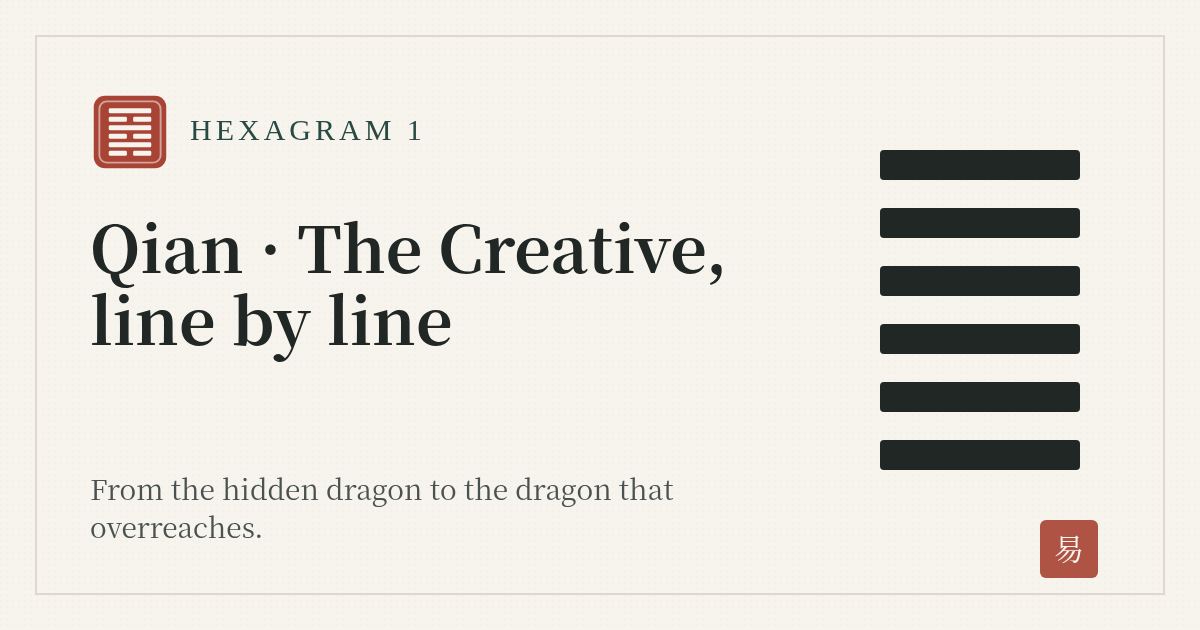
The figure
- Upper trigram: Qian, Heaven
- Lower trigram: Qian, Heaven
- Lines: all solid (yang)
- Paired with: Hexagram 2, Kun, The Receptive — its complete opposite
Because every line is yang, any changing line in Qian turns a yang line into yin, introducing receptivity into pure strength.
The judgment
乾:元,亨,利,贞。 The Creative: sublime, successful, furthering, persevering.
These four characters — yuan, heng, li, zhen — became some of the most discussed words in Chinese thought. Later commentaries read them as four virtues: origination, growth, benefit and steadfastness, like the cycle of a season from spring planting to winter storage. In a reading, the judgment says that a creative undertaking has every foundation for success if it is sustained with integrity. The emphasis on zhen, perseverance in what is right, matters: Qian's power is not a burst but a steady current.
The image
天行健,君子以自强不息。 Heaven moves with vigour; the noble person, in the same way, strengthens themselves without ceasing.
Heaven does not rest; day follows day. The image does not ask you to force outcomes but to cultivate an unflagging inner discipline. It is among the most quoted lines of the whole classic — and a good motto for anyone in a long project.
The six lines
Line 1 (nine at the beginning): The hidden dragon
潜龙勿用。 Hidden dragon. Do not act.
Potential is real but not yet ready to be seen. This is the season for preparation, learning and patience. Acting now would waste force. If this line changes, Qian becomes Hexagram 44, Coming to Meet.
Line 2 (nine in the second place): The dragon in the field
见龙在田,利见大人。 Dragon appearing in the field. It furthers one to see the great person.
Ability becomes visible. It is a good time to meet mentors, collaborators or people who can recognise your work. Influence comes from sincerity and competence, not position.
Line 3 (nine in the third place): Active all day, wary at night
君子终日乾乾,夕惕若厉,无咎。 The noble one is creatively active all day; at nightfall still vigilant, as if in danger. No blame.
The most human line. Work is intense and responsibility is growing. Danger lies in exhaustion or ambition outrunning judgement. Constant self-examination keeps you free of error.
Line 4 (nine in the fourth place): Leaping, or staying in the deep
或跃在渊,无咎。 Wavering flight over the depths. No blame.
A moment of choice: rise to a larger role, or remain where you are. Neither is wrong if the decision matches your true nature and timing. This line often appears at genuine crossroads.
Line 5 (nine in the fifth place): The flying dragon
飞龙在天,利见大人。 Flying dragon in the heavens. It furthers one to see the great person.
The ruling line of the hexagram: full expression, influence and clarity. Even at the peak, the text advises connection with others of quality. Success is shared, not hoarded.
Line 6 (nine at the top): The arrogant dragon
亢龙有悔。 Arrogant dragon will have cause to repent.
Strength pushed past its limit loses touch with others. This is the warning against overreach: the project that grows beyond its purpose, the leader who stops listening. If this line changes, Qian becomes Hexagram 43, Breakthrough.
All lines changing: a flight of dragons without a head
用九:见群龙无首,吉。 When all the lines are nines: a flight of dragons appears with no leader. Good fortune.
Unique to Qian and Kun, this extra text applies when all six lines change. Strength that does not insist on dominating — many dragons, none at the head — brings good fortune.
Reading Qian in practice
Work and projects. Qian favours initiative and sustained effort. Check which line is moving: line 1 says prepare, line 5 says lead, line 6 says scale back.
Relationships. Pure yang can mean energy and commitment, but also two strong wills meeting. Make room for receptivity — Qian's partner hexagram, Kun.
Decisions. The judgment supports a creative choice made with integrity. The lines tell you about timing more than about direction.
A common misreading
Getting Qian does not guarantee success. The hexagram's own lines include "do not act" and "will repent". Its message is closer to: you have real power here — use it with timing and humility.
Continue reading
Read the full commentary on the Qian hexagram page, compare it with its partner Hexagram 2, Kun, or cast your own hexagram.
Author

Categories
More Posts
I Ching vs. Tarot: What Is Actually Different?
Both are used for reflection and guidance, but they work in very different ways. A clear comparison of origins, structure, randomness, text and the kind of answer each gives.
Changing Lines and the Relating Hexagram, Explained
What moving lines are, why they matter most in a reading, how to form the relating hexagram, and a practical way to read one to six changing lines.
How to Ask the I Ching a Good Question
The question shapes everything you can learn from a reading. Here is how to frame open, honest questions the Book of Changes can actually answer — with examples to copy.